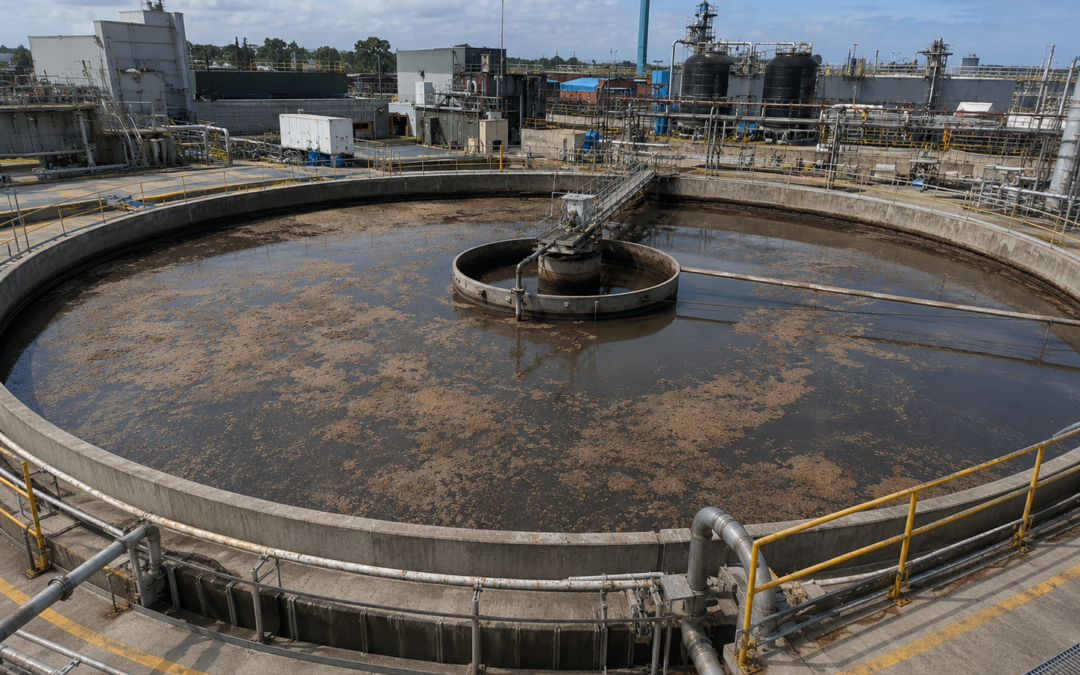
Primary clarifier performance is often overlooked. When TSS and BOD removal are adequate in a wastewater treatment system, then what’s the problem with an inefficient primary clarifier? One of it’s most significant – and costly - impacts is rarely quantified:
The long-term cost of solids accumulation and dredging
At many facilities, especially in the pulp and paper industry, poor primary clarification does not immediately trigger alarms. Effluent limits may still be met. But beneath the surface, a costly problem is building—literally.
A Simple Comparison: 80 mg/L vs 250 mg/L Primary Clarifier Effluent TSS
Consider a 35 MGD paper mill with two operating scenarios:
- Efficient primary clarifier: Averages 80 mg/L TSS
- Inefficient primary clarifier: Averages 250 mg/L TSS
Using standard mass balance calculations:
- At 80 mg/L → ~11.7 dry tons/day into ASB
- At 250 mg/L → ~36.5 dry tons/day into ASB
This results in:
An additional 24.8 dry tons per day entering the downstream system, or 9,000 tons/year that are preventable with a well-operated primary clarifier.
What Happens to These Solids?
They:
- Settle in ASB or Aerated Lagoon
- Reduce available treatment volume
- Contribute “Phantom BOD” when fiber and other organic material degrade slowly over time
- Ultimately requires mechanical removal (dredging)
Quantifying the Impact
Depositing excess solids into an ASB has a cost. While some anaerobic digestion of organic solids will occur, a considerable fraction of primary solids are inorganic, which will not degrade. Furthermore, anaerobic degradation can be very slow in the biologically active zone where bacteria are primarily focused on soluble BOD. Eventually, a majority of these solids will need to be mechanically removed via dredging once they are deposited in an ASB.
Over 5 years, the difference between an efficient and inefficient Primary Clarifier could cost the facility 2.26 million dollars in avoidable dredging costs
The Cost of Every mg/L of TSS at 35 MGD
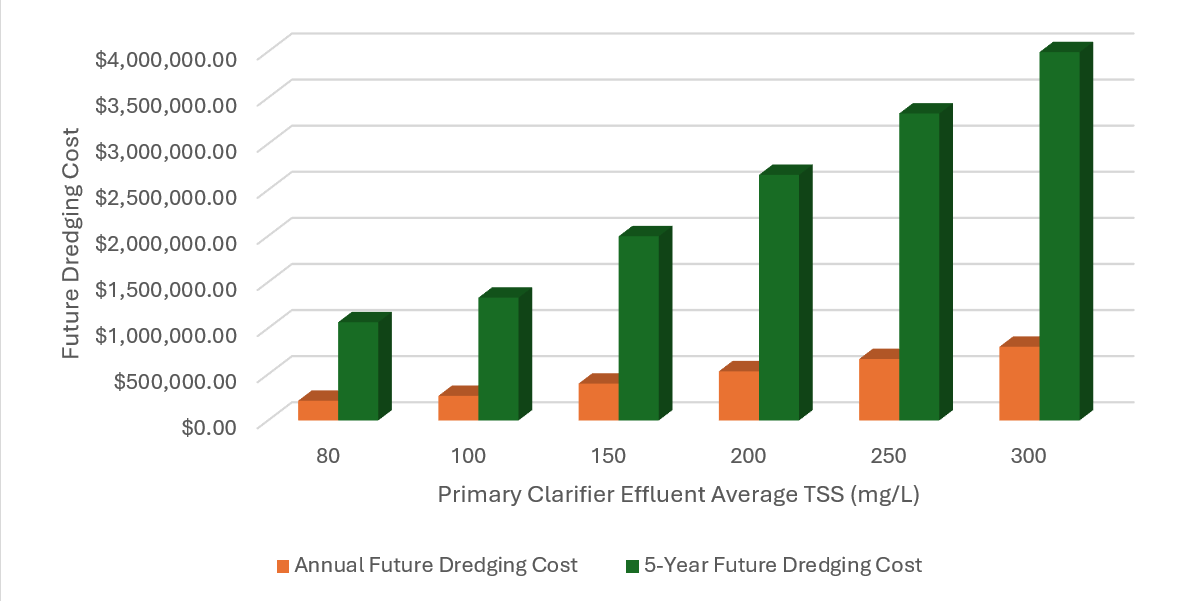
The chart above shows that incremental improvements in primary clarification can lead to large long-term cost savings.
Why is This Cost Often Missed?
Dredging is a lagging indicator.
The system may operate for years before:
- Capacity loss becomes noticeable
- Treatment performance declines
- Emergency dredging is required
By the time action is taken, the cost has already been incurred.
Primary Clarification: The Cheapest Point of Solids Removal
Solids removed in the primary clarifier are:
- Concentrated
- Easier to handle
- Less disruptive to downstream processes
Solids that pass through:
- Dilute into large volumes
- Settle unpredictably
- Require significantly more expensive removal methods
Operational Implications
Improving primary clarification performance is often one of the highest ROI opportunities in a treatment system.
Key focus areas include:
- Sludge blanket control
- Polymer optimization
- Hydraulic distribution
- Equipment maintenance
Even modest improvements can yield substantial savings.
How EBS Can Help
- Primary Clarifier Efficiency Evaluations:
- Depth Surveys: Determine total volume loss, where solids deposition is occurring, as well as providing third-party information regarding the impact of dredging projects.
- Tracer Studies: Determine actual retention time, flow patterns in ASB.
- Evaluation of Long Term Performance Trends: Assess how solids deposition and volume loss is impacting treatment over time.
Conclusion
- Primary clarifier performance is not just an operational metric; it is a financial driver.
- A difference between an efficient primary clarifier and an inefficient one can result in significant avoidable cost over the long term.
- The question is not whether those solids will be removed.
- The question is whether they are removed: now at low cost or later at a much higher cost.
If your facility has not recently evaluated primary clarification performance or solids accumulation trends, this is the opportunity to start. Fill out our Contact Us form with your facility details, and one of our EBS experts will be in touch!