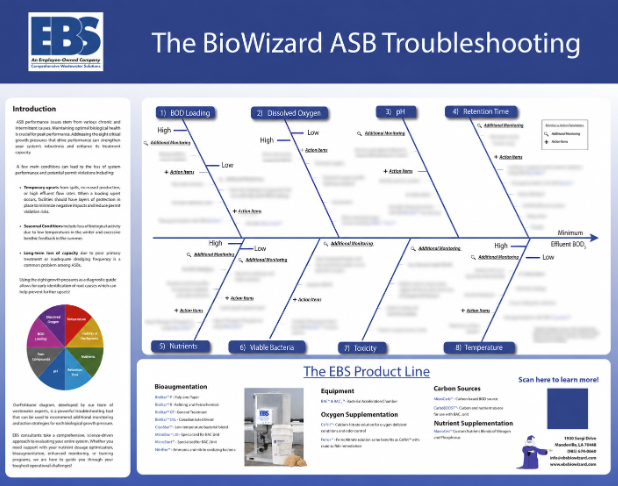
Aerobic biological wastewater treatment is based on the ability of microorganisms to utilize dissolved oxygen in the process of breaking down the soluble organic substances present in the process effluent.
The dissolved oxygen uptake rate (DOUR) test measures the respiration rate of organisms. Since it measures the rate at which oxygen is used (in mg O2/L/hour), it is a useful tool to evaluate process performance, aeration equipment, and biodegradability of the waste. Because solids are not controlled in an aerated stabilization basin (ASB), and the total suspended solids (TSS) is a direct function of biochemical oxygen demand (BOD) loading and biological activity, usually only the absolute uptake rate or dissolved oxygen uptake rate is monitored for aerated stabilization basins. For activated sludge systems, the DOUR is used to calculate a specific oxygen uptake rate, or SOUR, i.e., the amount of oxygen utilized in one hour by one gram of the volatile suspended solids in the activated sludge. Because the oxygen uptake rate is driven upward due to increases in BOD loading BOD, DOUR is a useful tool in detecting slug loading.
The oxygen uptake test is also useful in detecting toxicity. When toxins are present, the oxygen uptake rate decreases. If one knows the range of uptake rates that are normal for the plant it is easy to see when toxins depress the uptake test and the results can be used to screen wastewater for toxicity and better manage spills within the facility.
When interpreting DOURs, the individual numbers are not as important as trends over time. Therefore, DOUR testing must be done on a regular basis in order to for the results to be useful. DOUR samples should be taken from two or three points across the system over the period of the retention time for ASB systems. For activated sludge systems, DOUR samples should be collected at the outlet of the aeration basin.
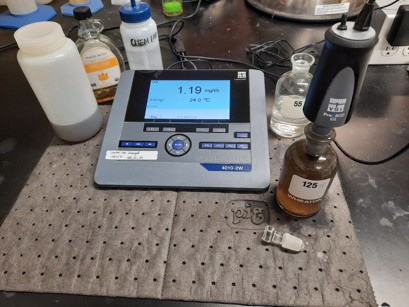
DOUR is calculated by measuring the dissolved oxygen (DO) of a sample for a set period of time (length of time may vary; at least 1 mg/L difference should exist between the start and end DO values) using a dissolved oxygen probe. The sample should be in a bottle that allows for a tight seal to form with the probe so that no outside oxygen is introduced. In general, a BOD bottle is use to measure the DOUR. Once the DO values are gathered the uptake rate is calculated using the equation below. Units are expressed in mg O2/L/hr.
DOUR, in mg O2/L/hr = (DO_initial - DO_final) * 60 / Length of test in minutes
For more information, please contact Environmental Business Specialists at 985-674-0660.