Contact Us
Subscribe
  • Onsite Support
    • Aerated Stabilization Basins | Lagoon Support
      • Wastewater System Evaluation
      • Historical Data Review
      • Depth Survey
      • Drone Survey
      • Performance Profile
      • Tracer Study
      • Laboratory Audits
    • Activated Sludge Support
  • Laboratory Services
    • Advanced Analytical Laboratory
      • Industry Specific Suites
      • Gas Chromatography
      • High Performance Liquid Chromatography
      • Heavy Metals
      • GC-MS
    • Treatability Laboratory
      • Inhibition Assessments
      • Biodegradability Studies
      • Nitrification Inhibition Assessments
      • Advanced Oxidation Processes (AOP)
      • Bench-scale Reactors
      • Microtox Acute Toxicity Testing
      • Customizable Treatability Studies
    • Microbiology and Wet Chemistry Laboratory
      • Microbiological Examination
      • Filamentous Bacteria Identification
      • Total and Live Bacterial Cell Counts
      • Nutrient Content in Biomass
      • Traditional Wet Chemistry
      • Ion Chromatography
    • Fecal Source Tracking Laboratory
      • Fecal Indicator Bacteria Testing
      • Microbial Source Tracking (DNA Markers)
  • Products | Equipment
    • Bioaugmentation
      • BioStar™ P
      • BioStar™ R
      • BioStar™ GT
      • BioStar™ DSL
      • CryoStart™
      • MicroStar™ 2.0
      • MicroStart
      • NitriFire™
      • BAC™ Units
    • Carbon Sources
      • MicroCarb™
      • CarboBOOST™
    • Nutrients
      • MacroGro™
      • BOOST™
    • Oxygen Supplementation
      • CalNit™
      • FerrOx
  • Training
    • Upcoming Events
    • Seminars and Workshops
    • Customized On-Site Training
  • Who We Serve
    • Pulp & Paper
    • Petrochemical
    • Food & Beverage
    • Municipal
  • Resources
    • Articles
    • Literature
    • Microbiology Gallery
    • Newsletters
    • SDS Directory
  • About
    • Leadership
    • Industry Trade Organizations
    • Philanthropy
    • Technical Advisory Council
    • Careers
Aerobic vs. Anaerobic Treatment in Wastewater Systems: Part 1

Aerobic vs. Anaerobic Treatment in Wastewater Systems: Part 1

by ebs | Nov 15, 2021 | Aerated Stabilization Basins

A Focus on Aerobic Treatment in Aerated Stabilization Basins (ASBs) There are 2 major types of systems used for wastewater treatment: aerobic and anaerobic systems. Each has different uses along with pros and cons. This particular article focuses on aerobic treatment....
Aerobic vs. Anaerobic Treatment in Wastewater Systems: Part 2

Aerobic vs. Anaerobic Treatment in Wastewater Systems: Part 2

by ebs | Nov 15, 2021 | Activated Sludge Systems, Aerated Stabilization Basins

A Focus on Anaerobic Treatment There are 2 major types of systems used for wastewater treatment: aerobic and anaerobic systems. Each has different uses along with pros and cons. This particular article focuses on anaerobic treatment. Aerobic treatment is the focus of...
Troubleshooting Aerated Stabilization Basin

Troubleshooting Aerated Stabilization Basin

by ebs | Dec 3, 2010 | Aerated Stabilization Basins

Aerated Stabilization Basin (ASBs) performance can be associated with numerous root causes, both chronic and intermittent. The three main conditions leading to loss of system performance and potential permit violations are discussed below. Temporary upsets due to...
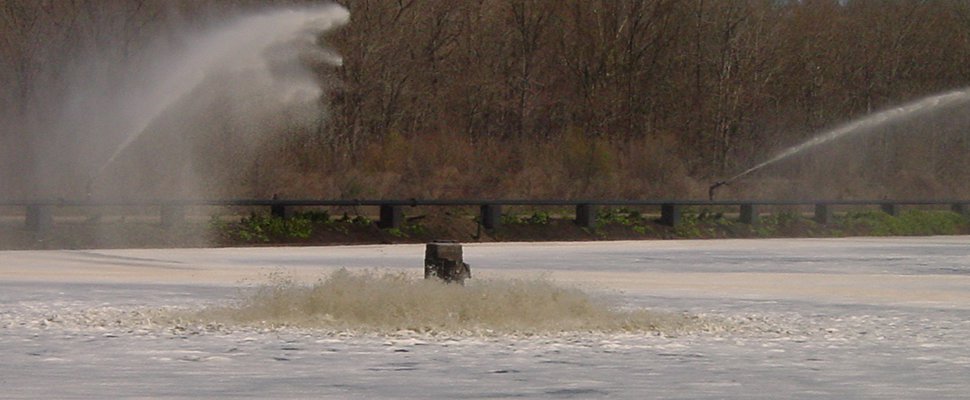
Filamentous Bacteria in Aerated Stabilization Basins Part 2

Filamentous Bacteria in Aerated Stabilization Basins Part 2

by ebs | Nov 18, 2010 | Aerated Stabilization Basins, Filamentous Bacteria Identification

Concern or Curiosity? Part 2 – Thiothrix and Type 021N Mike Foster, Principal Consultant – Environmental Business Specialists, LLCPaul Klopping, Principal Consultant – Callan & Brooks In part one of this series, we discussed the differences...
Filamentous Bacteria in Aerated Stabilization Basins: Part 1

Filamentous Bacteria in Aerated Stabilization Basins: Part 1

by ebs | Nov 18, 2010 | Aerated Stabilization Basins, Filamentous Bacteria Identification

Filamentous bulking has long been the bane of activated sludge operations. Biomass or sludge bulking is generally defined as mixed liquor with a Settled Volume Index (SVI) of >150 ml/g. However, sludge bulking does not definitively translate to a sludge bulking...

Categories

  • Activated Sludge Systems
  • Aerated Stabilization Basins
  • Bioaugmentation
  • Biological Treatment
  • Filamentous Bacteria Identification
  • Mixed Liquor Suspended Solids
  • Nitrification
  • Primary Clarification
  • Respirometry
  • Suspended Solids
  • The Eight Growth Pressures of Wastewater
  • Wastewater

Recent Articles

  • Denitrification Support with EBS CalNit™ 
  • Storm Preparedness and Recovery Plan
  • Improving the Performance of Activated Sludge Systems — An Operator’s Perspective
  • 6 Tips for Microscopic Evaluation of your Activated Sludge System
  • Running the Biochemical Oxygen Demand (BOD) Test

Contact Us

  (985) 674-0660
  info@ebsbiowizard.com

  • Disclaimer
  • Privacy
EBS © 2025