

The Importance of Primary Clarification: A Key to System Efficiency
Well-functioning primary clarifiers are essential for wastewater treatment efficiency. However, they are often overlooked when diagnosing the causes of declining effluent quality. Their primary function is to remove insoluble BOD and inorganic solids, thereby reducing the load on the biological treatment stage.
From a cost-saving perspective, primary clarifiers remove more BOD and TSS for less operational expense than any other treatment process. For systems with high solids leaving the facility, such as a paper mill, a primary clarifier is an integral part of the wastewater treatment system.
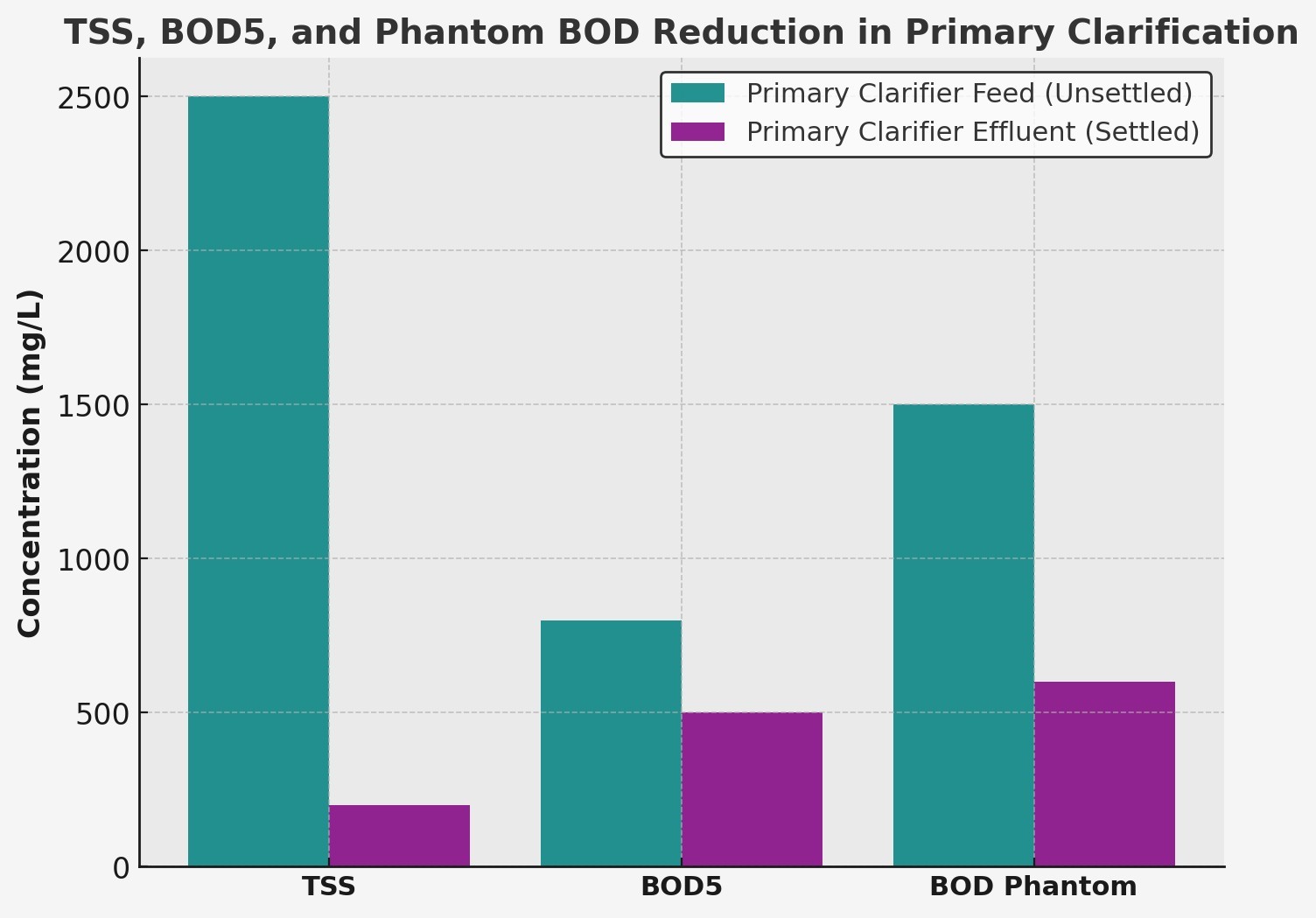
The diagram shows the difference between what enters the primary clarifier versus what leaves.
Green bars represent the TSS and BOD concentrations coming into the Unsettled Primary Clarifier Feed from the facility. If operators bypass the clarifier, this feed will go directly into the ASB or aeration basin.
Purple bars in the diagram represent the TSS and BOD concentrations in a typical Settled Primary Clarifier Effluent. These concentrations typically enter the ASB or aeration basin when the primary clarifier is functioning correctly.
Understanding Phantom BOD
Phantom BOD represents the insoluble portion of BOD that will not show up in the 5- day BOD test and generally impacts ASB where solids are deposited on the bottom of the basin. Over time, this fraction will break down to soluble BOD, creating additional oxygen demand later on. The primary clarifier significantly reduces the phantom BOD load to the ASB in this example.
Inefficient primary clarification or primary clarifier bypass might not have an impact on effluent quality in the short term, but additional solids loading into an ASB will increase the rate of volume loss, reducing the overall retention time of the system. Solids must then be mechanically dredged out of the basin for removal, which is done at a significantly higher cost than if they were removed in the primary clarifier in the first place.
Overloading Secondary Clarifiers
In activated sludge systems, solids breakthrough from the primary clarifier will increase the solids loading rate on the secondary clarifier(s). If secondary clarifiers are run with extra capacity, this may not cause an immediate issue for the system. However, many secondary clarifiers are operated close to their maximum capacity, and can quickly be tipped into failure, resulting in elevated effluent TSS and BOD, and possibly a permit exceedance if the situation is severe enough. While ASB systems can continue to operate normally in the short term during a primary clarifier bypass, most activated sludge systems cannot.
As seen in this diagram, a primary clarifier serves not only to reduce TSS but also a significant portion of BOD entering the biological part of the treatment system. Our experienced wastewater consultants can help you closely monitor trends in primary clarifier performance, providing early detection of issues before they escalate. We also help ensure the biological portion of your treatment system remains resilient, even during periods when primary clarifier performance fluctuates. Please reach out to EBS for a primary clarifier evaluation today!